Most back pain is harmless. Add leg weakness, though, and the question changes from “how do I ease this?” to “how fast do I need to act?” Sometimes the honest answer is “within hours.” More often it’s “within days,” and occasionally it’s “this will settle on its own.”
This article sorts the possibilities into three levels so you can judge where you stand. It’s general education, not a diagnosis. If you’re unsure, a same-day assessment from a doctor, a neurosurgeon in Noida, or the nearest emergency department is always the safer choice.
Why Leg Weakness Changes Everything
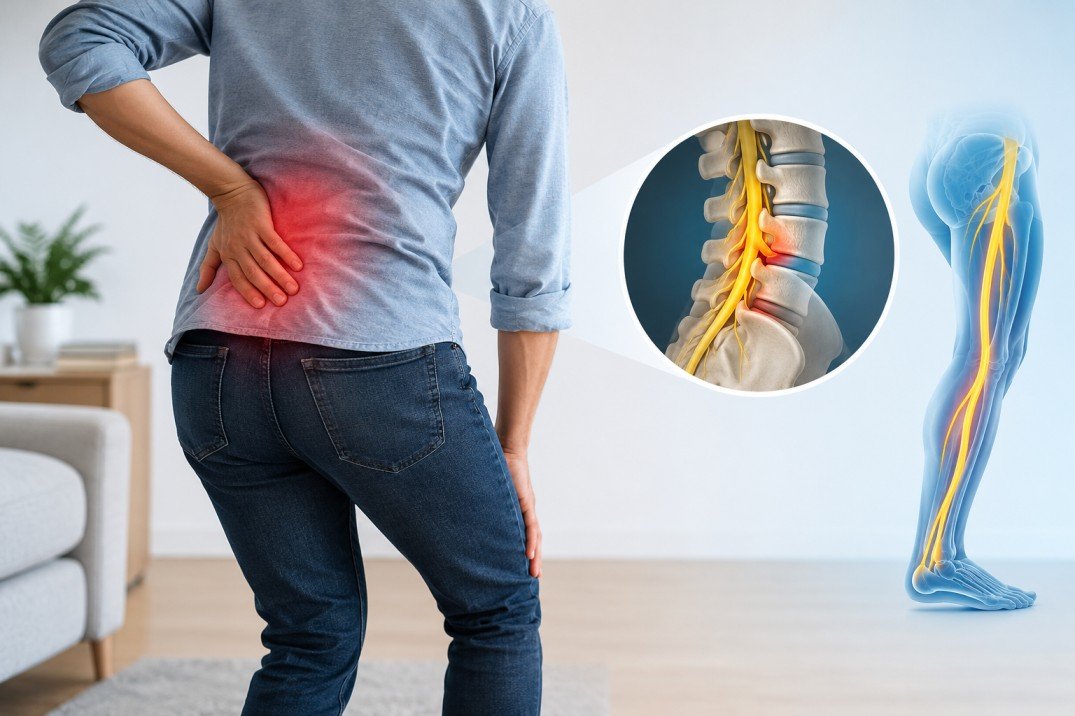
Pain tells you something is irritated. Weakness tells you a nerve or the spinal cord isn’t carrying its signals properly. A nerve root squeezed by a disc can cause both. But when the compression is severe or involves many nerves at once, waiting can lead to damage that doesn’t fully recover.
That’s why doctors treat “painful” and “painful plus weak” so differently, even when the pain level is identical.
The Three-Level Check
Red: Go to an Emergency Department Now
These signs suggest cauda equina syndrome or spinal cord compression, both time-sensitive:
- Numbness around the genitals, buttocks, or inner thighs (the “saddle” area)
- Difficulty starting urine, a weak stream, not feeling the bladder fill, or new leakage
- Loss of bowel control, or not feeling when you need to go
- Weakness or numbness in both legs, or weakness that is spreading quickly
Cauda equina syndrome is a perfect case in point. This condition develops when a bundle of nerves in the lower part of the spinal canal gets pressed, usually due to a massive prolapse of the disc. Decompressive surgery is normally considered most effective when performed prior to the loss of bladder function, and recommendations usually suggest performing it within 24-48 hours from the onset of key symptoms. Do not delay seeking medical attention, and avoid driving yourself to the hospital.
Amber: See a Doctor Within a Day or Two
- Foot drop: the front of your foot slaps down or catches when you walk
- A leg that is clearly weaker than the other and getting worse over days
- Back pain accompanied by fever, unexpected weight loss, or a previous cancer diagnosis.
- Back pain after a fall or accident, especially in older adults or people with osteoporosis
- Recent spinal procedure or injection, diabetes, or an immune-suppressing condition alongside fever and back pain (infection needs ruling out)
None of these guarantees something serious. But each one needs a proper examination and usually an MRI soon, not in three weeks.
Green: Reasonable to Monitor, With a Plan
Pain that travels down one leg without real weakness, no bladder or bowel changes, and no numbness in the saddle area usually belongs here. Sciatica from a disc often improves over weeks with activity modification, physiotherapy, and pain relief prescribed by a doctor.
Green isn’t permanent, though. If it hasn’t improved after four to six weeks, or any amber or red sign appears, move up a level.
A Quick Way to Check Your Own Legs
If you’re unsure whether you’re weak or just sore, try these. They’re a rough guide, not a medical test.
- Stand and rise onto your toes of one foot, holding a wall for balance. Repeat on the other side. A clear difference suggests calf weakness.
- Walk a few steps on your heels. Difficulty lifting the front of the foot can point to foot drop.
- Sit and straighten each knee against gentle resistance from your hand. Note if one side gives way.
- Notice whether you can feel light touch equally on both sides of your inner thighs and buttocks.
- Pay attention to urination and bowel habits over the past day or two.
If any step reveals something new or one-sided, treat it as amber at minimum.
Which Conditions Can Sit Behind These Symptoms
| Condition | Typical Clues | Urgency |
| Lumbar disc herniation with sciatica | Leg pain worse than back pain, one side | Usually non-urgent unless weakness is progressing |
| Cauda equina syndrome | Saddle numbness, bladder or bowel change, both legs affected | Emergency |
| Lumbar spinal stenosis | Leg heaviness or cramping on walking, eased by sitting | Usually routine, sooner if worsening |
| Spinal cord compression (neck or mid-back) | Clumsy hands, unsteady walking, stiff legs | Urgent to emergency |
| Spinal infection or abscess | Fever, severe constant pain, risk factors | Emergency |
| Spinal tumor or metastasis | Night pain, weight loss, cancer history | Urgent |
| Stroke (can mimic leg weakness) | Sudden one-sided weakness, face droop, speech trouble | Emergency, call for help immediately |
That last row matters. Sudden weakness on one side of the body, especially with facial drooping or slurred speech, is not a spine problem until proven otherwise. It needs emergency stroke care.
What Happens When You Get Seen
Expect a history and a neurological examination first: strength, reflexes, sensation, and often a check of the saddle area and bladder function. An urgent MRI is the standard imaging test when red or amber features are present. Blood tests may be added if infection or cancer is a concern.
If compression is confirmed, a neurosurgeon or spine surgeon will discuss whether surgery is needed and how soon. In emergencies this conversation is brisk, because the timing itself affects recovery. In non-emergency cases, a spine specialist in Noida or elsewhere should discuss non-surgical options first and explain the reasoning behind any recommendation, including the risks and the chance that you’ll improve without an operation.
Common Mistakes People Make
One such mistake is waiting for the discomfort to become intolerable. The symptoms of cauda equina syndrome may start off surprisingly mildly, with numbness or changes in urination being a symptom rather than pain.
Another such error is blaming the “tired leg” on aging or fatigue when the condition has been worsening silently for weeks already. Yet another such mistake is treating a painful sensation with massages or other manipulations, which should never be done in case of weakness.
Frequently Asked Questions
Can back pain with leg weakness go away on its own?
Sometimes, particularly when a disc is irritating a single nerve root. But weakness shouldn’t be assumed harmless. If it’s getting worse or hasn’t improved, get examined.
How quickly should I act if I notice bladder changes with back pain?
Immediately. Go to an emergency department the same day and mention your symptoms clearly, including any numbness in the saddle area.
Is an MRI always needed?
Not for every case of back pain. It’s strongly indicated when there are red flag symptoms, progressive weakness, or pain that hasn’t responded to a reasonable period of treatment.
Will I definitely need surgery if I have leg weakness?
No. Mild weakness from a single irritated nerve often recovers with conservative care. Surgery is considered for emergencies like cauda equina syndrome, significant or worsening deficits, or persistent symptoms with matching MRI findings.
The Final Word
Back pain with weak legs lies on a spectrum. On the one side is a simple irritated nerve that heals itself. At the other extreme is compression of the spinal cord or cauda equina where time is of essence. The factors differentiating between the two are clear-cut: saddle anesthesia, changes in the functions of bladder and bowel, bilateral lower limb weakness, and progression of weakness. In the presence of any of the above, seek immediate emergency medical attention and worry about sorting out the finer points later. Otherwise, proper assessment by an experienced neurosurgeon or spine surgeon in Noida will help identify the underlying problem and offer possible solutions.

Dr. Rahul Gupta is Senior Director and Head of Neurosurgery at Fortis Hospital, Noida, with over 20 years of experience in the assessment and management of brain, spine, and nerve disorders. His clinical practice includes minimally invasive brain and spine surgery, brain tumour management, neurovascular procedures, and other neurosurgical treatments. Treatment recommendations are based on each patient’s diagnosis, medical history, and individual clinical needs.