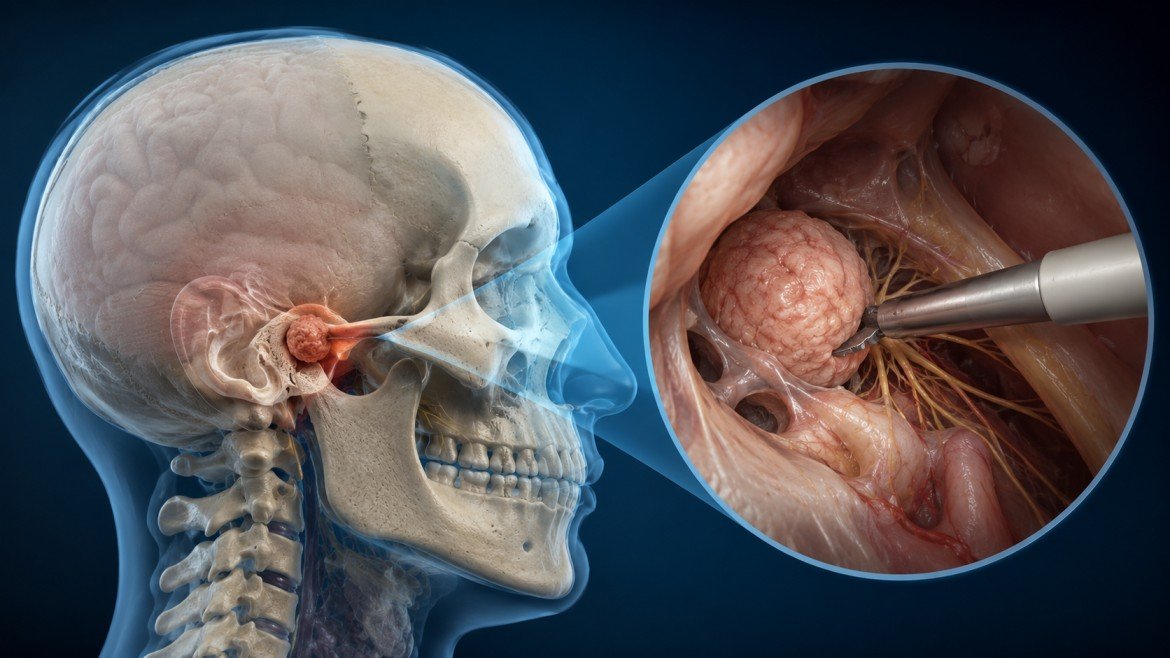
“So you’re going to open my skull?” One of the first questions patients often ask after learning about a skull base tumor is whether surgery will require opening the skull. In many cases, the answer may be no. A good chunk of these tumors get removed through the nose. Not metaphorically — actually through the nostril, using an endoscope, with no visible incision on the head at all.
That single fact changes how a lot of patients think about their diagnosis once they hear it explained properly.
First, What Even Is the Skull Base?
Picture the floor of the skull — the bony platform the brain actually sits on, separating it from the sinuses, the eye sockets, and the upper part of the nasal passage. Tumors growing along this region include pituitary adenomas, meningiomas near the base, craniopharyngiomas, and certain chordomas.
Because this area sits so close to the nose and sinuses, it’s oddly one of the few brain regions that’s naturally reachable without cutting through the skull from above at all.
Myth: Every Brain Tumor Needs the Skull Opened
This is probably the biggest misconception patients carry into a consultation, and it’s an understandable one — most people’s mental image of brain surgery comes from movies, where a surgeon is always working through an opened skull.
Reality: location decides the approach, not the fact that it’s a brain tumor. A tumor on the surface of the frontal lobe genuinely does need a craniotomy — opening a section of skull to reach it directly. But a pituitary tumor sitting at the base of the brain, right behind the nose, is often closer to the nostril than it is to any spot you’d normally cut through the skull to reach.
How the Nose Becomes a Surgical Pathway
The procedure is called endoscopic endonasal surgery, and it works roughly like this. A thin endoscope with a camera on the end goes up through the nostril, through the natural sinus passages, and the surgeon removes a small amount of bone at the back of the sinus cavity to reach the tumor directly. No skin incision, no shaving of hair, no visible scar anywhere.
It sounds almost too simple for something this delicate, but the sinuses and nasal passages naturally lead almost directly to the base of the skull — the body already has a route there, and surgeons learned to use it.
What Makes a Tumor a Good Candidate
Not every skull base tumor qualifies. A few things typically need to line up:
- The tumor sits at or near the midline of the skull base, within reach of the nasal corridor
- It hasn’t grown extensively into surrounding brain tissue or wrapped tightly around major blood vessels
- Its size is manageable through a relatively narrow surgical corridor — very large tumors sometimes still need a combined approach
Endoscopic vs Open Surgery
| Factor | Endoscopic Endonasal Surgery | Open Surgery |
| Access route | Through the nose and sinuses | Through an incision and skull opening |
| External incision | Usually no large scalp incision | Usually required |
| Suitable tumors | Selected tumors in accessible locations | Many complex or laterally extending tumors |
| Brain retraction | Can reduce the need in appropriate cases | May be necessary depending on approach |
| Recovery | Often less invasive | Can involve a longer recovery |
| Limitations | Restricted by anatomy and tumor extension | Greater surgical exposure but potentially more tissue disruption |
Neither approach is universally “better” — the tumor’s exact position decides which one actually applies.
What Recovery Actually Looks Like
Patients are often surprised by how quickly they’re back on their feet after an endonasal procedure compared to what they expected from “brain surgery.” Most spend two to four days in the hospital, compared to closer to a week for an open craniotomy. Nasal packing stays in for a short period afterward, and there’s some congestion and reduced sense of smell temporarily, but this usually improves within a few weeks.
That said, “less invasive” doesn’t mean “minor.” The recovery still involves careful monitoring for cerebrospinal fluid leaks, one of the specific risks tied to operating through the nasal passages, since the barrier between the sinuses and the brain is thinner in that region.
When Is Open Surgery Still the Right Choice?
This isn’t a story where endoscopic surgery has simply replaced the older method. Some tumors genuinely need a craniotomy:
- Tumors located away from the midline, particularly toward the side of the skull base
- Tumors that have grown extensively into brain tissue rather than staying more contained
- Cases where the tumor has wrapped tightly around major arteries, making a narrow endoscopic corridor too risky
- Very large tumors where the endonasal approach alone can’t provide enough visibility or access
A good surgeon won’t force a case into the endoscopic approach just because it’s less invasive on paper. If the anatomy doesn’t support it safely, open surgery remains the right choice, even if it sounds like the more difficult option to a patient hearing about it for the first time.
When Is Open Surgery Still Necessary?
Open surgery has not become obsolete.
A traditional or minimally invasive craniotomy may be considered when a tumor extends significantly to the side, involves critical structures that cannot be safely reached from the nose, is very large, or requires a surgical angle that an endoscopic corridor cannot provide.
Some tumors may also require a combined approach, using both endoscopic and open techniques. For certain skull base cancers, the extent of disease and the need to achieve appropriate oncological margins can determine whether a purely endoscopic operation is appropriate.
The goal is not to avoid a craniotomy at any cost. The goal is to choose the route that gives the safest and most effective treatment.
What Patients Should Actually Ask
If you’re being told your tumor could be treated endoscopically, a few questions are worth raising directly:
- How many endoscopic skull base procedures have you personally performed?
- What specific risks apply to this approach for my tumor’s exact location?
- If the endoscopic approach turns out to be insufficient during surgery, what’s the backup plan?
- What does recovery typically look like for someone with a tumor similar to mine?
Someone genuinely experienced with this technique — often the kind of surgeon patients are searching for when they look up the best brain surgeon in India — will answer these without hesitation, because they’ve navigated these exact conversations many times before.
Frequently Asked Questions
Is endoscopic skull base surgery newer and therefore riskier than traditional surgery?
It’s been used clinically for over two decades now, and for the right tumor types, outcomes are comparable to open surgery, often with a considerably easier recovery. It’s not experimental — it’s a well-established alternative for specific cases.
Can all pituitary tumors be removed this way?
Most can, since the pituitary gland sits almost directly behind the nasal cavity. Larger or more complex pituitary tumors occasionally need a combined approach, but the majority are treated endoscopically today.
Does going through the nose mean a higher infection risk?
The nasal passages carry their own bacteria, so surgeons take specific precautions — antibiotics and careful sealing of the surgical site — to manage this. Infection rates with proper technique are generally low and comparable to open procedures.
Is open surgery always more invasive or less effective?
Not necessarily. Open surgery can provide wider exposure when a tumor is large, lateral or anatomically complex. The appropriate approach depends on the individual tumor rather than a simple “open versus minimally invasive” comparison.
Conclusion
Skull base tumors can sometimes be removed without open brain surgery, particularly when their location and anatomy make an endoscopic endonasal approach appropriate. But this is not suitable for every tumor. Some cases require surgery or combined surgery because open surgery gives safer access and better control of critical structures.
For patients considering treatment the important decision is not simply avoiding open surgery. Understanding the tumors anatomy, pathology and treatment goals and choosing an approach that balances tumor control with protection of brain function, vision, nerves and blood vessels is essential, for open surgery.
Dr. Rahul Gupta is Senior Director and Head of Neurosurgery at Fortis Hospital, Noida, with over 20 years of experience in the assessment and management of brain, spine, and nerve disorders. His clinical practice includes minimally invasive brain and spine surgery, brain tumour management, neurovascular procedures, and other neurosurgical treatments. Treatment recommendations are based on each patient’s diagnosis, medical history, and individual clinical needs.