A patient once described it to me as feeling like someone hit her jaw with a live electrical wire, then walked away like nothing happened, and came back to do it again twenty minutes later. Her dentist had already pulled two teeth by that point, chasing a pain source that was never in the teeth at all. This mix-up happens more than people realize, and it’s worth understanding why, because the difference between trigeminal neuralgia and an ordinary toothache is actually pretty clear once you know what to look for.
The nerve doesn’t know the difference, even if the cause is completely different
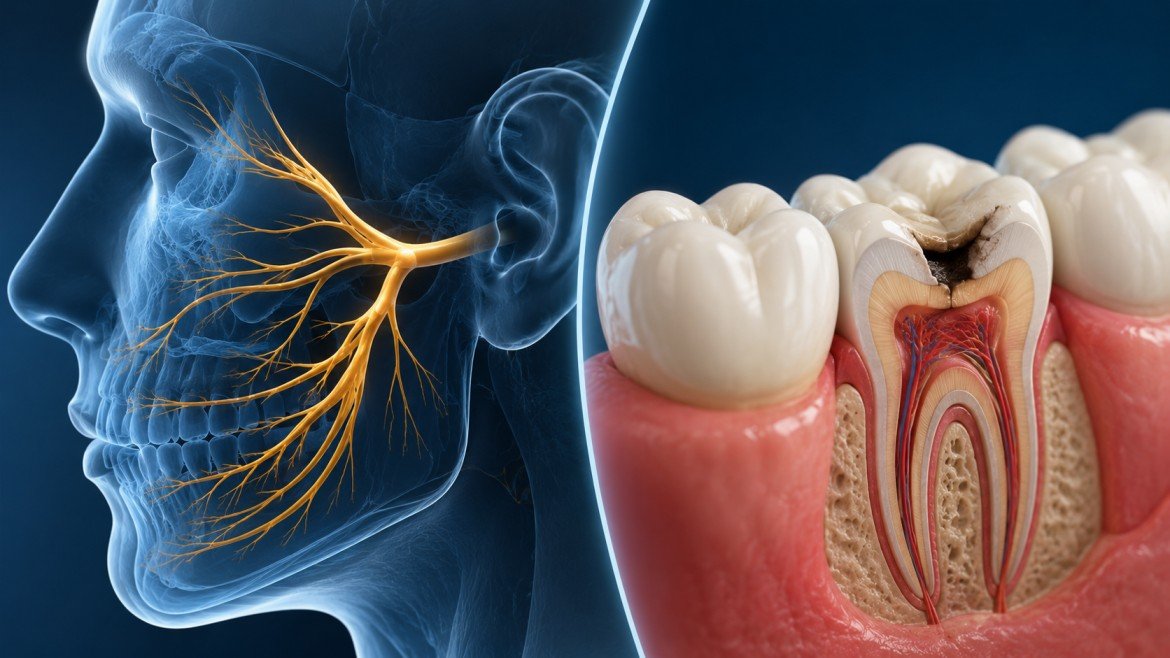
Here’s the thing that trips up so many patients and even a few dentists: the trigeminal nerve supplies sensation to the teeth. So when the nerve itself is the problem — irritated, compressed, misfiring — the brain can register that as tooth pain even though the tooth is fine. X-rays come back clean, a root canal doesn’t help, and everyone’s left confused about what’s actually going on.
It’s not a small percentage of cases either. Enough trigeminal neuralgia patients go through unnecessary dental work first that it’s become something neurologists specifically ask about during intake: “Did you have any dental procedures before this started?”
What the pain itself is actually telling you
A toothache has a rhythm to it. It builds, it’s usually there constantly once it starts, and it tends to get worse with hot or cold touching the tooth. Take a painkiller and it eases off for a while. There’s almost always something visible causing it — a cavity, an abscess, a crack.
Trigeminal neuralgia doesn’t behave anything like that. It’s sudden. Patients describe it as an electric jolt, a stabbing sensation that lasts anywhere from a couple of seconds to around two minutes, and then it’s just gone — completely, until the next one hits. Between episodes, most people feel entirely normal, which is oddly one of the more telling signs. A toothache doesn’t usually give you that kind of clean break.
The triggers are the other giveaway. Chewing sets off a toothache. Trigeminal neuralgia gets triggered by things that have nothing to do with eating at all — brushing teeth, wind on the face, talking, even a light touch from a towel while washing up. Patients often learn to avoid touching one side of their face entirely, which tells you something about how unpredictable the trigger threshold really is.
| What you’re checking | Toothache | Trigeminal Neuralgia |
| How it feels | Steady ache, sometimes sharp | Sudden shock-like burst |
| How long it lasts | Hours, until treated | Seconds to about 2 minutes |
| What sets it off | Hot/cold food, chewing | Light touch, talking, wind |
| Does medication for pain help | Usually, yes | Often barely touches it |
| What a dental exam shows | A clear cause, usually | Nothing abnormal |
| Pain-free gaps | Rare | Common, sometimes long |
A few patterns worth paying attention to
If several of these sound familiar, it’s a reasonable signal to stop chasing dental explanations:
- Something as light as a cotton swab against the cheek can set off full pain
- Episodes cluster for a while, then disappear for weeks or months without explanation
- The pain never crosses to the other side of the face
- Dental X-rays and exams keep coming back clean
Where this actually comes from
Most of the time, it’s mechanical — a small artery near the brainstem pressing against the trigeminal nerve right where it exits the brain. That pressure, sustained over years, wears down the nerve’s protective coating until it starts firing pain signals on its own, without any real trigger behind it.
Less often, something else is responsible — multiple sclerosis, or occasionally a tumor sitting against the nerve. This is why imaging isn’t optional before treatment starts. It’s not just confirming what everyone already suspects; it’s making sure nothing more serious is hiding underneath a familiar-looking symptom.
What treatment actually looks like, step by step
Nearly everyone starts on medication, typically an anticonvulsant like carbamazepine. It doesn’t numb pain the way a painkiller would — it calms down the nerve’s overactive signaling at the source. For a good number of patients, especially early on, this genuinely works.
It doesn’t always hold up over time, though. The dose that controls pain can climb, and with it comes drowsiness, dizziness, sometimes a mental fog that makes medication harder to tolerate than the condition itself felt in the beginning.
When that happens, there are a few paths forward:
- Microvascular decompression surgery repositions the blood vessel that’s pressing on the nerve. It’s the option most likely to give lasting relief because it deals with the actual mechanical cause, not just the symptom.
- Gamma Knife radiosurgery targets the nerve with focused radiation, no incision involved — usually the choice for patients who aren’t good candidates for open surgery.
- Balloon compression or a glycerol injection offers a less invasive route, with a shorter recovery, though the relief tends to wear off sooner than what surgery provides.
Which one makes sense comes down to age, general health, what the MRI actually shows, and how well medication worked before it stopped.
When it’s time to stop seeing the dentist about this
Sudden facial pain triggered by touch rather than food, especially if it’s sharp and brief rather than a dull constant ache, is a reason to see a neurologist or neurosurgeon. An MRI will usually settle whether there’s actual nerve compression behind it, and rule out anything more serious.
Questions people usually ask
Can a dentist catch this during a regular exam?
They can rule out cavities, infections, cracked teeth — the usual dental suspects. But confirming trigeminal neuralgia itself generally needs a neurologist and an MRI of the nerve.
Does it ever resolve without treatment?
It can go quiet for a while, sometimes for months, but it tends to come back. Full, permanent resolution without treatment is unusual.
Is surgery the only real fix?
No — plenty of people manage well on medication for years. Procedures come into the picture mainly once medication stops working or the side effects get too disruptive.
Can stress make episodes worse?
It doesn’t cause the nerve compression itself, but a lot of patients notice their episodes get more frequent during particularly stressful or exhausting stretches.
The Final Word
Once you’ve seen both side by side, the difference isn’t subtle — a toothache builds and responds to painkillers, while trigeminal neuralgia strikes without warning and barely responds to anything until the nerve problem itself gets treated. Getting this right early spares people unnecessary dental work and gets them to the actual source of the pain faster. If facial pain keeps showing up as sudden electric jolts and your dentist keeps finding nothing wrong, proper trigeminal neuralgia treatment — medication first, procedures only if that stops working — is what actually addresses it.

Dr. Rahul Gupta is Senior Director and Head of Neurosurgery at Fortis Hospital, Noida, with over 20 years of experience in the assessment and management of brain, spine, and nerve disorders. His clinical practice includes minimally invasive brain and spine surgery, brain tumour management, neurovascular procedures, and other neurosurgical treatments. Treatment recommendations are based on each patient’s diagnosis, medical history, and individual clinical needs.